Chicago Black Belt
Native SonChicago Black Belt is the racially restricted area in which the novel locates Black residents’ homes and sharply limited opportunities. It is not merely a backdrop to Bigger Thomas’s life: housing policy, unequal rents, segregated public space, and police action make the district an instrument of confinement. The novel sets the daily costs of that confinement against white claims of benevolence, then shows how quickly the Black Belt becomes the target of an extraordinary citywide search.
Definition and Setting
The Black Belt is presented as a bounded residential zone on Chicago’s South Side, sustained by the refusal to rent to Black people in other parts of the city. In his questioning of Mr. Dalton, Max connects that policy to the concentration of Black families in one area. The resulting boundary is not simply a matter of where residents happen to live: it narrows their access to housing elsewhere and makes their location a condition imposed by property owners and the larger social order.
Max’s argument in court makes the spatial constraint personal. He tells the judge that Mr. Dalton’s company rents to Black residents in the Black Belt while refusing them homes elsewhere, and that this arrangement kept Bigger apart from Mary. In Max’s account, the boundary kept Bigger and Mary strangers to one another, even though Bigger worked in the Dalton household. The image of Bigger being kept in a forest gives the district a force beyond its map: it suggests enclosure within a separate world, rather than free movement through the city.
Housing and Economic Dependence
The novel makes the Black Belt’s material conditions specific through the Thomas family’s housing. Max challenges Mr. Dalton over the eight dollars a week charged to the family for one room without ventilation, where four people eat and sleep and rats are present. He contrasts that rent with Mr. Dalton’s donations to educate Black people. The contrast directs attention from the stated generosity of charity to the continuing arrangement that extracts rent from a family living in inadequate housing.
That disparity gives the Black Belt an economic as well as a residential meaning. The same real-estate system that restricts where Black families can live also benefits from their dependence on the limited housing available to them. Max argues that a landlord’s profits and charitable giving cannot be considered separately from the conditions under which those profits are made. In his account, the donation may ease hardship without changing the housing policy that helps produce it. The neighborhood’s deprivation is therefore tied to a wider pattern of ownership and restricted choice, not represented as an accidental feature of one household’s circumstances.
Institutional Boundaries and Public Space
Max broadens his argument from housing to the systems that keep Black residents within imposed limits. He describes restrictions on education, residence, employment, and participation in public life, presenting them as connected practices rather than isolated acts. His speech turns the Black Belt into a visible part of a wider structure: people are directed where to live, what schooling they may receive, and what kinds of work they can do.
The courtroom itself reflects the division Max describes. He draws attention to Black people seated together behind a railing, separated from white people, and argues that this arrangement expresses an understood boundary even without an explicit order to sit apart. The scene carries the Black Belt’s logic into an institution beyond the neighborhood: segregation is reproduced through social expectations as well as through formal policies. The district thus represents one concentrated form of a broader separation that shapes daily life and public institutions.
The Search and the Neighborhood’s Narrative Role
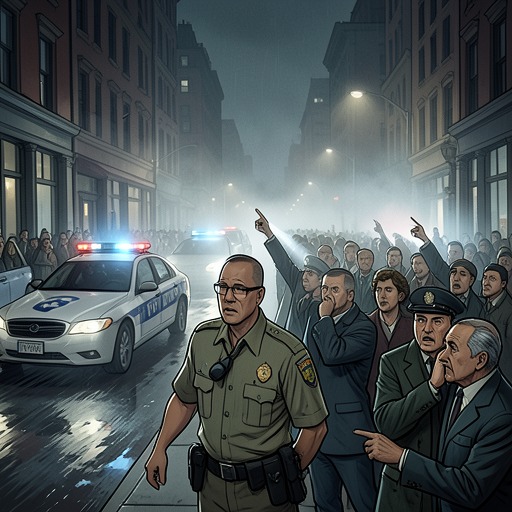
After Mary’s remains are discovered in the furnace of the Dalton home, the news and the authorities’ language frame the case through the threat of a sex crime. The ensuing search reaches beyond the place where evidence was found. Police and vigilantes stop vehicles and public transport leaving the South Side, search Black homes under a blanket warrant, and examine abandoned buildings. The pursuit turns the Black Belt and adjoining Black neighborhoods into spaces of surveillance. Reports of Black men being beaten and white parents’ demand that schools close show how the case fuels fear extending beyond the investigation itself.
This crisis gives the Black Belt a further narrative function: it reveals the unequal consequences of racialized suspicion. The search treats Black residence as grounds for scrutiny, while the public rhetoric surrounding the case risks defining Bigger before he is captured. The novel’s account of the neighborhood is therefore both material and political. Its crowded housing and restricted choices establish the conditions of everyday life; the mass search shows those same boundaries becoming a system for policing an entire population. Read together, these episodes make the Black Belt not a passive setting but a space continually produced by housing decisions, segregation, and state power.